New tools were used to disseminate traditional military messages with little regard for a new online culture of communication.
How times have changed.
Nearly four years later, the IDF’s social media strategy is much more sophisticated, offering online audiences regular and engaging updates on the progress of Israel’s military activities in Gaza – Operation Pillar of Defense.
Comparing 2009 with 2012: YouTube and Twitter
The differences are striking. In the 2009 post, I included a link to this YouTube video:
As I noted at the time, this bland ‘press statement’ delivered by Capt. Benjamin Rutland takes place in a washed out ‘non-place’ with the Israeli flag propped up against the wall. Not exactly engaging content.
It’s a far cry from the IDF’s most recent YouTube videos which now include short, snappy infographic explainers:
And dramatic images of “precision strikes” in which the viewer is on-board with the missile, transported to a video-game like first person perspective:
(These videos offer a compelling illusion – apparently taking the viewer closer to the conflict, but at the same time distancing the viewer from the human cost as airstrikes appear to primarily affect buildings, infrastructure or only the most ‘evil’ of enemies.)
Back in 2009, Twitter was mainly used as a way of linking to exceptionally dry updates on the IDF Spokesperson blog which were often written in impenetrable military jargon. On both the blog and the Twitter feed there was little evidence of the IDF trying to influence, drive and engage in the conversation around the conflict.

Now the IDF Twitter feed is being written in plain English. What’s more, the IDF is using hashtags (#IsraelUnderFire), encouraging Twitter users to retweet their content and creating imagery that the IDF believe will be circulated by online communities.
It is also posting all manner of facts and figures and commenting on the issues which might affect the outcome of the battle for public opinion.
From 2009 to 2012: The IDF’s social media learning curve
In 2009, Noah Shachtman revealed in Wired just how ad hoc the planning for the social media element of the information war had been during Operation Cast Lead, describing the IDF’s YouTube campaign as “off-the-cuff” – a last-minute idea by a group of “twenty-something” soldiers.
Shortly after Operation Cast Lead, the IDF’s Twitter fell silent for 179 days and only began updating again in August 2009. In December, Haaretz reported that a new media unit would be set up to engage online audiences on Facebook, YouTube and Twitter.
In the three years since then, the IDF has clearly revisited its approach to social media. According to Reuters the Israeli foreign ministry invested $15 million dollars in social media in 2010 and although the IDF was still learning it was notable that their YouTube channel was beginning to attract the attention of news journalists by the time of the Gaza flotilla raid in May 2010.
A ‘behind-the-scenes’ TV report demonstrated how the online presence of IDF Spokesperson was updated by a fully operational “New Media desk” by 2011.
Communicating conflict: The blurring boundaries
The 2012 online media campaign for Operation Pillar of Defense is undoubtedly a significant ‘improvement’ in Israel’s attempt to communicate their version of the conflict using social media tools. But challenges remain.
In particular, the use of Twitter more explicitly blurs an already blurred boundary between psychological operations and public information campaigns.
In the last few days, the IDF has addressed all manner of online audiences with its Twitter feed.
Some updates are probably designed to be picked up by journalists – announcing the onset of the airstrikes via Twitter rather than in a news conference was an interesting departure, but hardly surprising given the widespread adoption of Twitter by journalists at media organisations.
A tweet on Sunday was even more obviously directed at journalists:
Advice to reporters in #Gaza, just like any person in Gaza: For your own safety, stay away from #Hamas positions and operatives.
— IDF (@IDFSpokesperson) November 18, 2012
The IDF’s Twitter feed is also trying to leverage an active online community which is supportive of Israel’s goals by producing content which can be disseminated online through retweets on Twitter and sharing on social networks. Other content, such as the YouTube explainers, can be seen as an attempt to convince sceptics of Israel’s military operation.
These activities might all fall into the remit of public information campaigns, but at the same time the account is being used for purposes which could be viewed as a function of psychological operations.
One IDF tweet issued a warning to Hamas operatives and as Stuart Hughes pointed out on the BBC’s College of Journalism blog the IDF’s Twitter account has attracted the attention of Hamas’ military wing, the Al-Qassam Brigades.
It is no longer unusual for a war of words on Twitter to accompany armed confrontation. (See also: ISAF Media vs the Taliban and the Kenyan Army vs Al Shabaab.)
Communicating messages successfully to different audiences in the same space is problematic, particularly when the ‘audience’ can write back. Critics have argued that the IDF’s Twitter feed is a distasteful addition to an immoral military campaign. The Now Lebanon blog, for example, headlined a post with the title: ‘IDF cheerily live-tweets infanticide‘.
And the unanswered question is this: what difference, if any, will the IDF’s more coherent approach to social media make?
A template for the future?
It is perhaps too soon to make a judgement, but the IDF’s social media campaign in support of Operation Pillar of Defense might prove to be a template for future information operations online as militaries attempt to influence a more fiercely contested informational battlespace.
In 2010, Lt. Gen. W. Caldwell, Dennis Murphy and Anton Menning published an article in the Australia Army Journal in which they suggested that the US military could learn from the IDF’s use of social media.
I think they were wrong then in relation to the Gaza conflict in 2009, but they might have subsequently been proved right by events in 2012.
]]>
Dutch video journalist Ruud Elmendorp spent almost a week in Mogadishu, the embattled Capital of Somalia, at the end May. The insurgents led by the Al Shabab and Al Hizbul movements are trying to topple the internationally recognized government of president Sheik Sharif Ahmed. In this guest post for the Frontline Club, Ruud reports from the urban war zone.
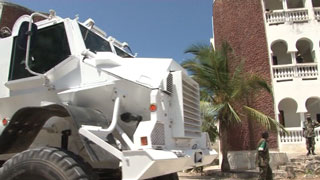
We’re in Villa Somalia in the centre of Mogadishu for a meeting with Somali president Sheik Sharif Ahmed. This is the State House of Somalia, and it’s a pleasant white multi-storey villa on a separate compound in central Mogadishu. The trees here are blossoming pink, and the soft breeze waves through the leaves. But this compound and the adjacent blocks are heavily guarded by AMISOM soldiers. They are here with heavy armored vehicles, and on every corner there are soldiers seated with big guns. These are the days of mortar attacks, and Islamists insurgents, named Al Shabab (‘the youth’) who seem to be advancing.
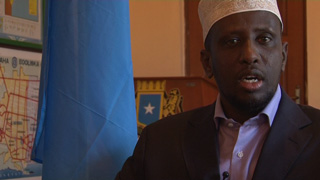
In one of the room we meet with president Sheik Sharif Ahmed (pictued above) who now is something of a trophy for the insurgents.
"I feel absolutely safe here," says the president with a smile. He is speaking to us the press. We have just been checked thoroughly at the gate, where we also had to leave our helmets and flak jackets. The president is urging the international community to pay more attention to his country.
"We have an influx of foreign fighters who support the insurgents. Who knows what happens when they manage to take over," President Sheik Sharif is referring to a Taliban style society the world first saw in Afghanistan.
While we are in Villa Somalia we can hear some mortar fire. We are well aware that a car bomb can explode any moment, killing either AMISOM peace keepers, civilians or journalists. So far they have not hit the villa of the president, which is in fact the only territory he reigns at the moment. Nothing more than one acre in the whole of Southern Somalia. Most of the rest of Mogadishu is under the loose control of the Al Shabab. A president with no country calling for support. It’s almost like the beginning of a fairy tale.
Armour
The last few days we have been traveling through Mogadishu in armoured vehicles. The windows are made of seven centimeters of thick glass, and the metal hull is the same gauge. We wear flak jackets and helmets, especially when filming from the hatch in the roof. Meanwhile we are protected by soldiers holding .50 machine guns. Mogadishu passes us by, and looks like one big open air museum of destruction.
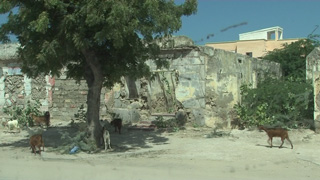
Along the main road from the Parliament to the busy Kilometer Four junction not a single building has windows. Everything made of wood has been removed. Few people walk the streets here anymore. Only herds of goats can be seen eating the grass which grows on the sidewalks almost like they are the next generation of city dwellers.
Hundreds of people were killed in the battle over the last few weeks, and some 70,000 fled Mogadishu, which was already almost deserted. As a journalist the thing to do is to report on these terrible things happening, and I did. Still that doesn’t cover the whole story.
On the same destroyed road in the city centre I just saw a romantic couple walking hand in hand, carefully avoiding the pot holes in the road. The flowering trees are still blossoming for them, and the boys armed with AK47s don’t disturb the young lovers. And that brings an interesting dilemma about what to report. Several miles away lively city life continues. With markets, packed mini buses, and people sitting on the streets drinking their tea, and some of them chewing the local drug of choise, qat. Like there is no war at all.
At the same time, in our armoured vehicle, we pass one of these city markets. I’m standing outside the hatch, trying to capture some of the images you can see on this blog post. Reporting daily life with a flak jacket doesn’t really work, and I wish we could go outside, but the commander of the vehicle refuses,
"If we have one dead white man here, the insurgents will see that as a victory." Several jounalists have been killed and/or kidnapped in Mogadishu. The majority are local journalists. In recent days a famous reporter from the Mogadishu station Radio Shabelle was killed at Bakara Market. For them there are no armoured vehicles, maybe flak jackets, but they don’t really protect you. If a gun is pointed at you, there is nothing that can save you.
Mobile terror
Another ‘technical’ passes us by, no doubt the main contribution Somalia has made to world culture. These 4×4 pickups, with an anti aircraft gun mounted in the back, are manned by ten to twelve heavily armed boys. You usually see them roaming the streets, or at one of the many road blocks. One of the boys is wearing a red and white scarf, the sign of Al Shabab. Estimates say there are between 400 and 1,000 of these insurgents, terrorizing the whole country. They use sophisticated methods for that. Not only machine guns and car bombs, but most commonly by using sophisticated modern technology.
In Mogadishu I heard that Al Shabab have "call centres" from where they send "hate SMS messages" to the local population, threatening them with death if they resist. They also make phone calls, and rumour has it that there are video films circulating between mobile phones using Bluetooth. One of the films, it is said, shows a beheading performed by insurgents. It goes some way to explain why it is so very difficult to get an opinion from the population on what is taking place in Mogadishu.
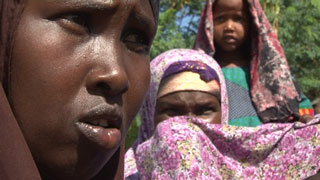
We visit an health post outside the city centre. People are lining up to register. It’s not clear whether they are really sick, or if they are just looking for shelter. One young lady in a brown scarf is quite explicit, "I am a woman. I cannot talk about these things. That will give me problems."
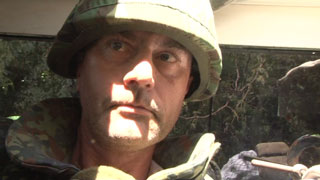
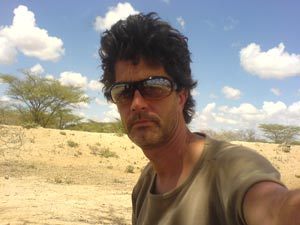
Indeed, under extremists women are not allowed to talk about politics. The armoured vehicle drives us to a safe place for the evening. Over the next few days and weeks I’ll be working on the footage I compiled in the Somali capital, if you’re interested in learning more please drop me a line. Greetings from Mogadishu. That’s me pictured above.
UPDATE: Here’s the video report from Mogadishu,
]]>
It wasn’t much more than a speck. A tiny, white fleck in the wide blue sky above us. Our 4×4 lurched to a halt as Yahia, the driver, peered through the 10 inches of windscreen scraped clean of the mud that camouflaged the rest of the vehicle. Then we were off again, lurching over the rutted earth of North Darfur in a straight line for the nearest cover: nothing more than a spindly thorn tree.
We parked up with the car barely hidden by the branches and the three rebels and I sat down in the dust, shaded by other trees.
The Antonovs were out hunting. After guerrillas with the Justice and Equality Movement seized the town of Kornoi the government planes were out on the hunt every morning and evening. We had been spotted. Maybe it was a glint from the RPG launcher hanging from the wingmirror or the plume of dust that we kicked up pelting helter-skelter through the desert. Either way the Antonov high above was turning in tighter and tighter circles overhead.
Read the full blog post on Rob’s blog.
]]>
Steve McCurry is one of my favourite photographers. Famous for his images of Asia, his work is always a pleasure to come back to. His richly-textured collection South Southeast is one of just a handful of photo books to have carved out a space on the small bookcase in our living room. Perhaps more importantly, he captured the iconic photograph of Sharbat Gula (or "Afghan Girl") which made the cover of National Geographic and made both McCurry and Afghanistan worldwide stars.
Anyway, McCurry, very much a man of the film age, has started a digital-era blog. If I’m honest (and I’m no-one to judge) it’s a comically bad effort. By that I mean it looks awful – straight off a basic WordPress template and with several bits of the pre-fillled text and descriptions left in place. There aren’t even any pictures. But there are words, wise words, and for that I’ll be checking Steve’s blog regularly for updates.
Read the full blog post on Adam’s blog.
]]>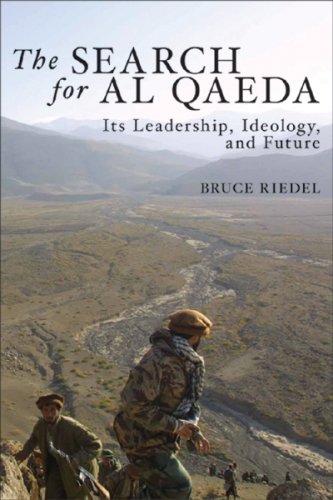 By now Bruce Riedel is pretty well-known, so I’ll spare you the CV: intimately involved in US foreign affairs in this general area (Afghanistan, Pakistan, India, Central Asia etc) he helped run one of the reviews of Afghan policy that Obama requested at the beginning of the year. Nowadays he’s still quite active; writing, advising and so on. He’s also the author of In Search of Al Qaeda: Its Leadership, Ideology and Future (pub. Brookings, 2008).
I put together some thoughts on his book, and some final thoughts on a recent essay he wrote for CTC Sentinel, the journal of the ‘Combating Terrorism Center’ at West Point. Occasionally I’ll quote from the book and respond to things that he says.
General Comments
In Search of Al Qaeda: Its Leadership, Ideology and Future was published in late 2008 and offers an outline of the author’s views on the threat posed by ‘Al Qaeda’ in the past, as well as possible ways to engage with the situation and “how to defeat al Qaeda”. A short book, it is presumably intended for as wide an audience as possible, and as such it is not rigourously sourced, nor is the writing style academic in any sense.
It begins with an recap of the basic facts of the 9-11 attack, covering all the traditional details of the plot as well as outlining some of the conclusions that he wants to explore in the rest of the book. The following four chapters are structured around four character he believes to be central to the story of al Qaeda, each representing a separate strand of that narrative: “The Thinker: Zawahiri”; “The Knight: Osama”; “The Host: Mullah Omar”; and “The Stranger: Zarqawi”. He ends the books with some thoughts on the current threat as well as his plan for ‘defeating al Qaeda.’
The most puzzling feature of this structure – out of which he explains his conception of al Qaeda – is the inclusion of Mullah Omar as a fundamental feature (a full one quarter of the narrative) of al Qaeda. The author of these comments has not read an account of al Qaeda to date which makes a claim as bold as this for the role that Mullah Omar played. Nor have I heard any claims that Mullah Omar was involved (to whatever level – Reidel is frustratingly unclear) in the planning or strategic decisions that lead to 9-11. This in itself is not evidence to support a claim, but I have been engaged in Afghanistan and in research on the issues relating to jihadism and Islamism for at least eight years and had not previously heard this claim.
Read the full blog post on Alex’s blog.
]]>
In a couple of days she’s rocketed up from a handful of followers to around four thousand. So far, we’ve heard of her ariel acrobatics, as her husband pilots the royal helicopter – we’ve found out about her taste in films and her struggle to be a mother and queen. And it’s all written in irritating txt spk.
It seems to be the real deal. CNN’s Octavia Nasr is sure it really is Rania logging-in to Twitter.
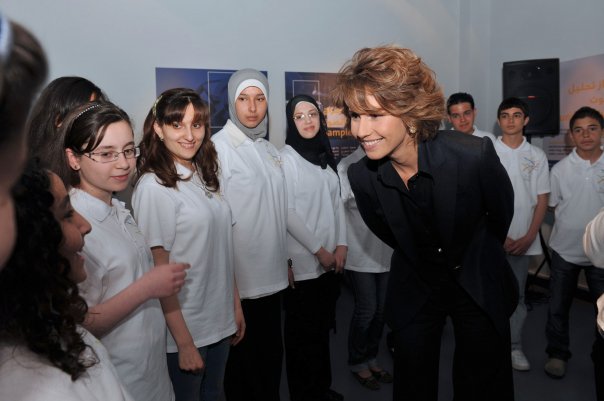
North of the border, Syria’s First Lady Asma Al-Assad is also jumping on to the technological bandwagon. She’s on Facebook, talking about her charity work. Appropriately, she’s helped launch a project to get disadvantaged children online.
Let’s face it, politics is a popularity contest. And with the absence of Western-style free and fair elections in the region, what better way to measure their appeal than by social networking sites. Queen Rania comes in at 4000 Twitter followers (although she just registered a couple of days ago, so that figure will grow). Asma Al-Assad tops the lot with 9000 on Facebook.
]]>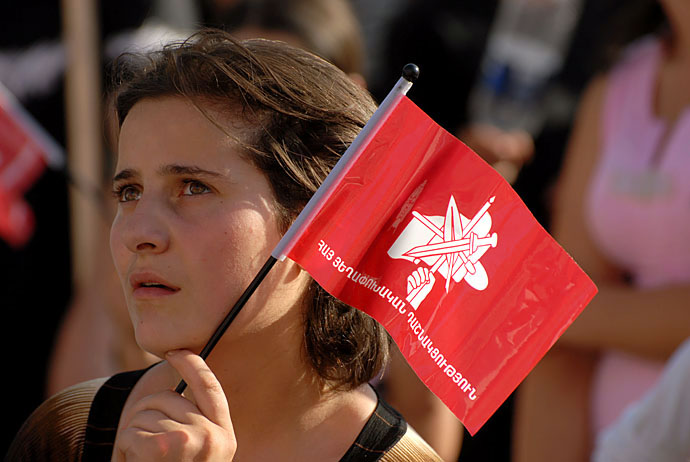
Nothing is ever simple in the South Caucasus, and no sooner had world leaders hailed a ground-breaking announcement from Armenia and Turkey that might set the scene for the normalization of relations between the two estranged neighbors, than nationalists throughout the region became agitated. Here in Yerevan, the Armenian Revolutionary Federation — Dashanktsutyun, for example, announced that it would leave the coalition government it has been supportive of for over a decade.
True, what appears to be U.S.-led efforts to bring the Armenia and Turkey together was always going to to irk the party which still lays claims to territory not only in the country’s western neighbor, but also in Azerbaijan and Georgia, but despite similar threats in the past, this has been the first time the ARF-D appears to have followed through. On Monday, the party formally announced its departure from government.
In a written statement, the Dashnaktsutyun leadership in Armenia reiterated the nationalist party’s condemnation of an agreement on the normalization of Turkish-Armenian relations announced by the two governments on Wednesday. “We also have fundamental disagreements with the Armenian authorities’ position on some issues raised during Armenia-Turkey negotiations,” it said. link
That the party has lasted this long in government is more of an issue, however, with many of its supporters believing that the move long been been overdue. Banned in the mid-90s, allegedly for forming an armed gang in preparation for a coup d’etat planned to oust Armenia’s first president, now extra-parliamentary opposition leader, Levon Ter-Petrossian, the party rose to power through unflinching support his successor, Robert Kocharian.
A decade of falsified elections, spiralling corruption, human rights abuses and a 20-day state of emergency declared after last year’s post-election clashes which left 10 dead, the party now seeks to position itself as a "constructive" alternative opposition to a government it has otherwise loyally served. Yet, coming as it does just a week before the start of the campaign period for next month’s crucial municipal election in the Armenian capital, others are not so convinced.
Seeking to attract the votes from those disgruntled by the authorities has been a feature of the ARF-D in every local, parliamentary and presidential vote since 2003. And this being Armenia, where opposition parties and their supporters are often subject to attacks and intimidation, many will not truly take the party at its word until there are signs that the authorities plan to frustrate and disrupt their activities.
However, while two opposition youth activists and one online journal editor were attacked and beaten this week, the ARF-D instead appears to enjoy a special relation with its former colleagues in power. Although leaving the government ostenibly because of disagreements over foreign policy, they have also been allowed to retain control over two key parliamentary sub-committees. The move has raised eyebrows among members of the traditional opposition in Armenia.
Read the rest of this post on Onnik’s blog.
]]>You can’t have failed to notice that Mexico is in the grip of a swine flu outbreak. Schools, museums and theaters are shut, people have been warned by the government not to kiss or shake hands when they say hello, and around half the people on the street are walking around wearing surgical face masks.
But the swine flu outbreak isn’t just taking its toll on people’s health. Local businesses are also starting to suffer as customers stay away. Watch the video for more.