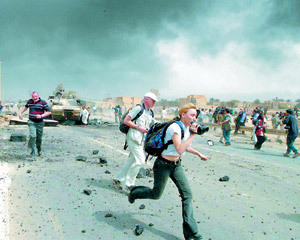
Bulgarian freelance journalist Elena Yoncheva has reported from many conflict zones for Bulgarian TV channels. She talks about her time in Somalia in The Standart newspaper today,
]]>Have you ever been under attack while on the move in Somalia?
I was twice on the verge of being kidnapped. Once we were followed by a jeep with five gunmen, who wanted to abduct us. Each time we take a different route when we go to or from a place, even when that place happens to be our hotel, which as a matter of fact is very well guarded. The locals see us as walking money sacks. One of my assistants here told me once he was driving at least ‘a million dollars’ in his car and he was referring to me! I am the only white woman in Puntland. In the beginning I thought Somalia wouldn’t be so scary, resting on my previous experience as a journalist, but I must admit I’ve never expected to see anything like it. link
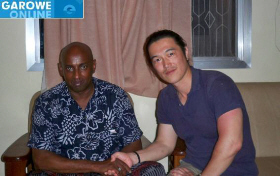
Given the utter chaos within Somalia, outright danger for journalists and the fact that freelancers Amanda Lindhout and Nigel Brennan remain hostages some 9 months after they were kidnapped outside Mogadishu, I was somewhat surprised to learn about Kenji Goto. He’s a journalist working for the "Independent Press" It appears he hooked up with a driver in Las Anod and travelled the 120km stretch of road to Garowe, arriving in the Puntland captial on Monday evening,
"I took a flight from Tokyo on Apr. 30 and spent a layover in Djibouti. I arrived in Berbera on Sunday," Kenji explained.
From Berbera, he hired a vehicle that transported him to Las Anod. Both towns are under the control of authorities in Somaliland, a peaceful region in northwestern Somalia that seeks complete independence from the rest of the country.
"Do you understand that this land [Puntland] has laws and security forces?" Planning Minister Dhala asked.
Kenji’s answer was as surprising as his trip: "Yes, Mr. Minister. But I wanted to go to the pirates place." Apparently, Somaliland authorities had misinformed him that Puntland is the "pirates place…"
"…I want the people of Japan to know the truth about this [piracy]," Kenji told me. "The world is sending warships…but I believe the world should send medicines and food to Somalia." link
Goto is staying in the Hotel Maka al-Mukarrama where he now has some protection from Puntland Special Protection Unit. I doubt the two American journalists with The New York Times journalists who are staying in the same hotel were allowed to travel in quite the same way as Goto.
]]>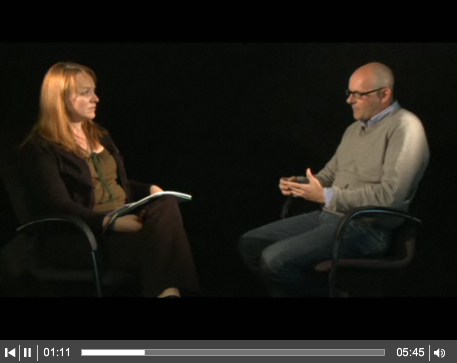
Peter Beaumont, Observer journalist who has reported from war zones for twenty years, talks about his experiences on the Guardian website with Tracy McVeigh today. The newspaper runs an excerpt from his latest book, The Secret Life Of War today. Peter will be at the Frontline Club on May 12 to talk more about his life as a journalist on frontlines around the world. Most interesting in the article at The Guardian is the postscript,
]]>It is not always the big things. Last September, on the eve of an ordinary assignment, I woke up and realised I never wanted to see an airport again. I didn’t want the smell or the sight of them. The grey, boring moments spent waiting in departures lounges I felt had eaten up my life. I didn’t make it to Heathrow.
It was a crisis that had been building for over a year. In my last year reporting from Iraq, something had happened. Rather than seeking the most meaningful stories, I had slipped into chasing the most dangerous ones. And in the process I had become someone I didn’t want to be. Not someone who wrote about the consequences of war, but someone who had become part of its logic.
When, on the last day of what would be my final trip in 2007, a car bomb exploded in front of the vehicle that I was in, it didn’t seem to matter. It was, I rationalised at first, an ordinary event in the country that is in conflict. Except that it did matter, in ways I could not then imagine. I dreamed about explosions. I jumped at slamming doors. I experienced periods of recklessness and of stultifying dissatisfaction. Two months later I found myself explaining why I never wanted to go back to Iraq again. And later still, why I had had enough of travelling.
The writing of The Secret Life of War was part of the crisis. In two-and-a-half years of working on it almost every day, I’d come to expect that when it was done, I would have written my last words about the conflict. But there was no sense of catharsis, no sense even of completion. Now at least I am happy with it for what it is, an attempt to deliver a personal, tentative and partial description of aspects of the experience of war.
But I am travelling again. This time I made it to Heathrow and Sarajevo. In January I covered the violent aftermath of the conflict in Gaza, and plan to return to finish a long-term project. I am not certain I understand fully what has changed. But I am no longer the person who came back from Iraq. Less confident and more careful, I have, I hope, reconnected with the person I once was – a person who cared about the victims more than the rituals of war.
I have realised too that everyone who is engulfed by war – willingly or not – loses something. For me that has been a connection to ordinary life, to my children and friends, and habits that, as I grow older, I have learned can never be repaired. In that knowledge, perhaps, there is a balance to be found. link
Was it liberating to find themselves without the BBC working alongside? Was it a daunting resonsibility? link
Just two of the questions Judith Townend at journalism.co.uk proposes to ask Al Jazeera journalists Sherine Tadros and Ayman Mohyeldin at 2pm GMT today. The reporters were the only English language reporters in Gaza during the Israeli attack in December, 2008. If you have questions for the duo you can add them in the comments here, or return to this post at 2pm GMT to watch the Q&A live in the Cover it Live box below.
]]>
Jeremy Page had a surprise wating for him upon arrival at Colombo’s Bandaranaike International airport in Sri Lanka. After multiple rejected visa applications to enter the country, The Times South Asia Correspondent decided to go the tried and trusted tourist visa route…
A message flashed up on his screen: “DO NOT ALLOW TO ENTER THE COUNTRY.” With that, my passport was confiscated, I was escorted to a detention room, locked up for the night, and deported the next day. I can’t say that I was surprised, though it was my first deportation in 12 years of reporting from China, the former Soviet Union and South Asia. link
The situation for Sri Lankan journalists both in and out of the country is dire – arrests, killing and the ban on reporting from inside the war zone continues unabated.
Photo of No Entry sign taken by autumn leaf
]]>]]>How difficult is it for you, as a journalist, to do your job in Mexico? I assume journalists feel constantly threatened as they cover stories about killings and crime.
First I want to point out that the Mexican journalists who live in Juárez and other conflict zones are most at risk. Some journalists have disappeared, and others have been killed over the past few years while covering the drug story. Attackers have targeted both newspaper and TV station offices in Mexico. Most recently, anchors at a Televisa station in Monterrey, Mexico, asked for help on the air when someone threw a grenade at the station during a newscast.
Even so, I used to feel a false sense of security in Mexico because I am a U.S. journalist. I think all of us working as correspondents in Mexico believed the drug traffickers did not want the extra attention that might result from killing a U.S. reporter. “It’s bad for their business,” law enforcement sources told us. I say a false sense of security, though, because I no longer believe this is true. I think the escalating violence proves anything is possible.
And even if you are not targeted as a journalist, just working in Juárez means you could get caught in the crossfire or killed by common thugs who are carjacking and kidnapping people. That’s a risk all Juárez residents run everyday. link
Reporter is a film about the work of New York Times foreign correspondent Nicholas Kristof. The film, produced by Ben Affleck, debuted at the Sundance Film Festival last week,
“As journalism of all kinds becomes more desperate to make money, then there is a tendency to focus more on celebrity,” Kristof said in a telephone interview from his home in the New York City area. “I just don’t know what’s going to happen to journalism, what our business model is going to be. I tend to think that one way or another, news and information will still have value.” link
You can catch a short interview with Affleck and Kristof with the LA Times above. The (somewhat dramatic and breathlessly wordy) trailer for the documentary is below. Anyone seen it in full? Any good? By the way if you haven’t seen the trailer to the Frontline Club’s own journalist documentary film, head over to Blood Trail now.
]]>Reuters snapper Finbarr O’ Reilly will be discussing his experience in the Democratic Republic of Congo and what first took him to Africa live online today, Wednesday, Jan. 14. Finbarr will use the excellent mobile phone video broadcast tool Qik to broadcast live at 17.00 GMT / 1200 ET. You can follow Finbarr on Twitter and ask him a question. Click the image above to go direct to the broadcast channel or follow the talk on the Reuters blog,
Amid the chaos of fighting, people fleeing their homes and the demand for quick news pictures, I tried to slow things down by taking intimate portraits.
By shooting with a very low depth of field, I hoped to extract my subjects from their surroundings and portray them as individuals with names and stories that matter.
More than five million people have died, most from lack of access to food or basic health, during a decade of fighting in Congo. This makes Congo ‘s enduring conflict the deadliest since World War Two. link
You can see the first part of the chat in the video above. The chat continues in the video below – after the connection has been cut.
]]>Unlike any war in Israel’s history, in this one the government is seeking to entirely control the message and narrative for reasons both of politics and military strategy.
“This is the result of what happened in the 2006 Lebanon war against Hezbollah,” said Nachman Shai, a former army spokesman who is writing a doctoral dissertation on Israel’s public diplomacy. “Then, the media were everywhere. Their cameras and tapes picked up discussions between commanders. People talked on live television. It helped the enemy and confused and destabilized the home front. Today, Israel is trying to control the information much more closely.” link
In related news, an Iranian TV journalist was arrested in Israel on Monday for “[violating] military censorship laws which forbade the news media from releasing information during the initial stages of the ground incursion.” The ‘propaganda war’ is one reason why some people are turning to alternative sources of information, as summed up by Frontline blogger Daniel Bennett.
]]>Raed Atharmneh works as a fixer in the Gaza strip. Al Jazeera put together a documentary about him in 2007. It’s a timely reminder of the work of fixers and journalists in Gaza at a time when many media outlets can’t even access Gaza to report on the war. You can watch part one above and part two below,
]]>Foreign reporters in conflict zones often rely on local ‘fixers’ – people who earn a living helping journalists get their stories. Raed Atharmneh is a fixer living and working in the Gaza Strip.
Filmmaker George Azar chose to film Raed’s daily life as he works to provide for 42 clan members. It was supposed to be a straightforward story.
But Raed’s world was about to be turned upside down by a terrible event which put Raed – albeit very briefly – at the very centre of international media attention. link