A packed audience filled the Frontline Club forum on 23rd October to hear a panel tackle the question: In whose hands should internet governance be entrusted? Chaired by the Chief Executive of Index on Censorship Kirsty Hughes the event, in association with BBC Arabic, featured: Icelandic MP Birgitta Jónsdóttir; developer for The Tor Project, Jacob Appelbaum; independent media technology consultant, Karl Kathuria and director at the Cyber Security Centre Dr Ian Brown.
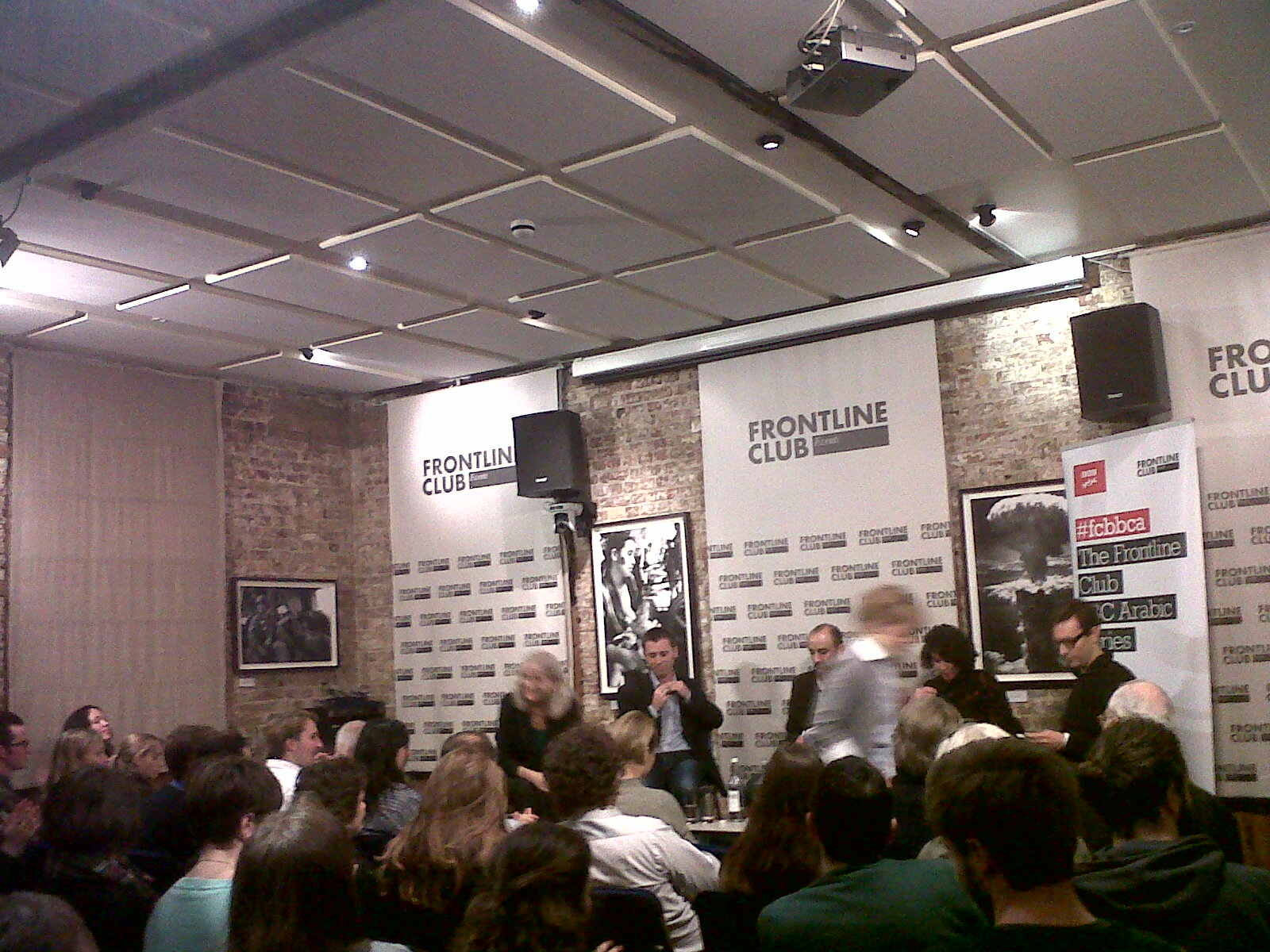
Dr Ian Brown kicked off proceedings by describing the distribution of power over cyberspace. Referring particularly to ICANN (Internet Corporation for Assigned Names and Numbers) which runs the international domain name system and although it is a “international facing” it is governed by US laws.
“Is it fair that this one powerful country the US should have such say over something that is a global resource?… Since so many large internet companies; the Googles, the Facebooks, the Twitters and so on, that are becoming increasingly important in internet governance debates, are headquartered in the US or at the very least have significant exposure to the US, and US law and case law has very firmly said that the behaviour of companies… with any assets exposed to the US had better watch out when it comes to their behaviour elsewhere in the world because there have been a number of US laws applied to the behaviour of these companies elsewhere in the world”
Karl Kathuria then moved on to discuss the censorship of information by governments from a more optimistic viewpoint, describing his time at the BBC on access to users in Iran and China:
“People were still able to get access to that content anyway, people are always looking for the content… its average everyday people who are reaching out.”
Birgitta Jónsdóttir has misgivings on calls for further global internet governance:
“Shouldn’t we have a global freedom of information act?… it is impossible… it would destroy the internet as it is today… maybe we need to start to look at this differently.”
Jacob Appelbaum, a core member of the anti snooping software Tor described the rise of cyber snooping and the oppression it can bring:
“Surveillance is a support system for violence.”
“What we see is a massive expansion of authoritarianism across the globe, even in so called free countries… the mere fact that it has gone so far and the American government has become so brazen.. is an incredibly bad sign, because in a lot of ways the US has led the world in these matters.”
“Freedom from suspicion is part of the necessity for feeling free… we should look at Facebook as stasi-book, and we should look at human data as human data-traffic. It is not a problem of over there-istan, it is a problem over here.”
Birgitta Jónsdóttir discussed the Iceland Modern Media Initiative as a solution to internet governance and excessive cyber snooping, and its uptake by the Icelandic Government to turn Iceland into a “safe haven” for freedom of information.
“Take the same concept as if you were to create a tax haven, so why not create the same for a freedom of expression and speech haven… if you have one country that sets the standard [other countries will rise to it]. I have a dream for a ‘Scandinavian Shield’… as the Scandinavian countries now have a good idea of the importance of these rights to bring the laws into the 21st century.”
Dr Ian Brown finished on a note about public uptake of new technology that can divert around any governmental snooping, “encouraging people to use the tools that already exist is the first step”.
View reaction to the debate on Twitter: #fcbbca, or watch the debate as it happened below.
]]>
The conflict and humanitarian issues Syria faces is at the forefront of many peoples minds at the moment, this was reflected by the full house that gathered at the Frontline Club’s panel discussion, Communicating about Syria – A humanitarian perspective on 10th October.
Lindsey Hilsum, Channel 4 News’ International Editor chaired a panel which included Hicham Hassan from the International Commitee of the Red Cross (ICRC); Lyse Doucet, BBC Chief International Correspondent; Ben Parker, head of the UN Office for the Coordination of Humanitarian affairs (OCHA); and Fadi Haddad from the Mosaic Initiative for Syria.
Hilsum started things off by asking Doucet to set out the current situation in Syria, where over a million people are now displaced within the country, 50% of which are children.
There can be no doubt that when it comes especially to war we [journalists] take the side of the people. And sadly it’s ugly terrible bloody wars that drag on there’s a lot of people that are affected and Syria is no different…And of all those people that are stuck in the middle one of the other sad realities of the Syrian conflict is that most of them are children.
Parker, who was only in London by coincidence on a break from his post in Syria as head of OCHA then spoke about how the problems in Syria are unlike any he has faced before.
I’ve never in my career spoken less to journalists. It’s a very unusual situation; aid agencies want to talk to the media for three things: 1. Cash. 2. To make sure that the attention doesn’t go away, and 3. We also have advocacy, in the sense that we want the people with power to take a certain course of action. In Syria, none of these three really work. In terms of the course of action, nobody has the answer. And what is the course of action? Stop the violence? ok…We’re heading into unknown territory.
There’s normally criticisms that we’re too tight with journalists… but here I can’t help you [journalists] at all, I can say maybe you should check out that school, but you being associated with me makes your job even harder. The state of Syria feels that the humanitarian people need to be watched just as much as the journalists because they have the potential to delegitimise and confuse and be instrumentalised by hostile forces.
Hassan who is the Middle East spokesperson for the International Commitee of the Red Cross (ICRC) said that the humanitarian aid is not there to solve the problems in Syria:
A very good friend of mine said: “The solution in Syria is not humanitarian because the problem in the first place is not humanitarian; it is political so don’t you think you guys are there to solve the problems.” It is true, we are not there to solve the problem, humanitarian aid is just there to push the limit a bit more and a bit more and a bit more.
Haddad from the Mosaic Initiative for Syria who works directly with human rights defenders and NGOs inside Syria and neighboring countries, gave some insight into how he gets supplies to people in Syria by foot through Turkey, but how even that is getting more difficult.
I’ve been targeted now more than the Free Syrian Army, if they know that there’s a field hospital in a place, they will try to shut it straight away. It’s getting more stressful.
When you’re dealing with these groups you need a good relationship with the local community and this is where journalists have to help us, as they go inside they know these communities so our mission is to work in partnership with them and to work like a middle agent between the international NGOs and the people on the ground.
Melissa Flemming, chief spokesperson for the UN High Commission of Refugees (UNHCR) was in the audience and Hilsum asked her to give her take on the situation. She finished with a final thought about the displaced people of Syria, before the discussion was opened to questions from the audience.
They’ve all lost family and they’ve all got horrendous stories to tell and they’re living in places like Lazatri camp which is inhospitable because of the landscape…It would be like any one of you who is used to living in an apartment having a high standard of living, and from one day to the next having to pick up everything probably having lost a lot and run for your lives across the border and try to make a life for yourself in a tent.
Listen to Lyse Doucet talk about the current state of affairs in Syria:
Listen to Lindsey Hilsum talk about the different kinds of people who have been caught up in the Syrian conflict:
Listen to Fadi Haddad talk about the problems he faces when getting aid to the people who most need it in Syria, he also tells the story of one man he couldn’t get aid to quick enough:
Watch the full event here:
]]>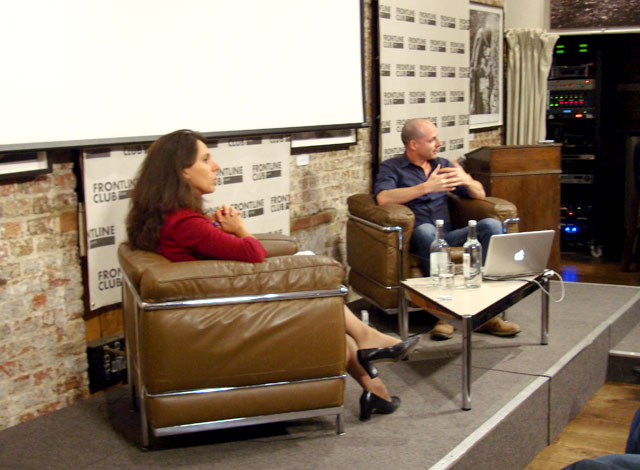
Aiming to dispel the familiar and stereotypical image of refugees living in camps World Press Photo Award winning photographer Andrew McConnell previewed a new body of work about the 50% of refugees now living in cities at the Frontline Club’s, In the Picture: Urban refugees with Andrew McConnell, on September 24.
Taken over the last four months, in seven cities and four continents, with the help of the International Rescue Committee (IRC), McConnell photographed and produced short films about individual refugees in cities such as Nairobi, Bangkok, Kuala Lumpur, Jordan, Port-au-Prince and New York.
Dr Sara Pantuliano, a political scientist and Head of the Humanitarian Policy Group at the Overseas Development Institute (ODI) introduced McConnell and he wasted no time in getting to his motivations behind the project:
"The whole reason for this project is this new phenomenon, that refugees no longer flee to camps, that the old stereotypes don’t really fit anymore. Over half the world’s refugees live in cities. And so what I hope to achieve with the work is to challenge those stereotypes and hopefully present a new way of viewing refugees in the modern world."
Pantuliano asked whether McConnell had any expectations about what he would find when starting the project:
"There were no huge surprises, I found what I suspected I would find. People living in terrible conditions, in very small cramped places, one family in one room … the same things repeated themselves; the same fears, fear of detention, the authorities, afraid to go outside."
The element of fear was not the only similarity that McConnell found between the people he met:
"They had an incredible resilience, they’ve suffered things that you and I can only imagine. That will to survive was there in each and every one of them – they weren’t giving up."
McConnell relayed the stories of the people in his photographs from a lady who had escaped with her family to Burundi from Congo where she had been kidnapped and raped by FDLR or Mai-Mai forces; to Syrians who had fled over the southern border into Jordan after conditions in Homs became unbearable.
He then took the audience through how he tried to convey these people’s stories through his images:
"The whole series was photographed at night time and what I’m really trying to do is give a sense really, how forgotten these people in cities are … They don’t understand what rights they have and so they’re afraid to go outside, they suffer discrimination, it’s hard to find employment and so they often find themselves hidden away."
"We were really here trying to give a sense of the isolation these people feel, coming to a foreign city like this and trying to some how survive."
McConnell has big plans for the project – there will be an exhibition in St Pancras Station in January and after that he hopes to take it to Brussels and New York.
Listen to Andrew McConnell on his photographs:
Listen to Andrew McConnell on why refugees choose cities instead of camps:
]]>
The significance of Polish journalist Ryszard Kapuściński was the topic of a heated debate at the Frontline Club on 19 September.
Fans and a few critics flocked to the Frontline Club to discuss the writers’ life with: renowned Polish journalist and recent Kapuściński biographer, Artur Domoslawski; Victoria Brittain, former associate foreign editor at the Guardian; John Ryle, a British writer and specialist in Eastern Africa; and Antonia Lloyd-Jones, an award winning translator of Polish literature.
Revelations about Kapuściński’s possible involvement with the Communist Polish secret service, after his death in 2007, polarised opinion about the veracity of his writing and legitimacy of his position as one of the great journalists of the twentieth century.
Antonia Lloyd-Jones, who translated Artur Domoslawski’s book to English, said:
The facts of Kapuściński’s biography don’t detract from Kapuściński as a writer. It made me want to read his books again.”
Lloyd-Jones’ thoughts reflect the tone of the debate; most wanted to focus on the singular brilliance and political significance of Kapuściński’s reportage, rather than possible inaccuracies. Victoria Brittain, an “unabashed Kapuściński fan”, referred to the event’s title Where does journalism end and literature begin? as “quite unhelpful”. “I think more interesting is Kapuściński,” she said.
Aside from the literary quality of his writing, Brittain said Kapuściński’s work was relevant and important. She recalled meeting people living in Angola during her time reporting there who read his book Another Day of Life about the Angolan civil war.
“…people in Angola lived with him, really enjoyed him and found the book told the story they wanted told”.
John Ryle, a lone detractor during the debate, said adulation of Kapuściński should not distract from questions over the truthfulness of the writer’s accounts.
“He was a great stylist, but if you are interested in the history of Ethiopia it is problematic,” he said.
Ryle was concerned that though readers in the west and Poland voice opinions on the significance of Kapuściński’s work, little attention is given to his subjects, particularly those in Africa.
“It is important not to allow our admiration for his style, I don’t think we should take that as an authority about the things he writes about,” he said. It is not just the “elasticity of the facts”, he added, “but the whole representation of Africa.”
To support his argument Ryle referred to the Granta article by Kenyan writer Binyavanga Wainaina, How to Write About Africa. “The main inspiration for the essay was Kapuściński,” said Ryle.
But Domoslawski staunchly defended Kapuściński, his work and his legacy. Kapuściński’s style derived from a school of reportage particular to communist Poland, he said, which was heavily censored at the time.
“Reportage became a description of the darker side of reality of life in Poland under Communism. The reporters changed the names of the people in order to [protect] them, they created fictional characters,” he said. “From the perspective of the free world you can say that is absolutely unacceptable in journalism.”
However, at the time it was necessary to convey a certain message. In reference to criticism of Kapuściński’s book The Emperor, about the last days of Haile Selassie in Ethiopia, Domoslawski said people reading it in Poland at the time saw it as an allegory of their own society. One of the sources for his book told him that, “The Emperor was the best Polish novel of the 20th century”. Domoslawski added: “I think Kapuściński wouldn’t mind [this accolade].”
Where does journalism end and literature begin? The question remained unanswered as both the audience and panel succumbed to the “great seducer” Kapuściński. However, insight into the creation of lyrical, yet accurate, reporting came from Domoslawski:
“Instinctively, you can write things that capture the spirit of the moment. You have to use real ingredients, you can’t make things up. There are some descriptions in Kapuściński’s books which are very poetic, they are literature but they are journalism.”
Watch the full discussion here:
]]>
At an event hosted by the Frontline Club, an expert panel of speakers shed light on the ongoing oppression of political opposition in Bahrain, one of the most under-reported aspects of the Arab Spring, and the government’s systematic use of Western public relations companies to manage the regime’s global reputation.
In the early months of 2011, thousands of Bahraini citizens took to the streets to demand greater representation and more equitable treatment of the country’s Shia citizens, who make up 70% of the population. Dozens were killed, and hundreds more were incarcerated or went missing.
But, as moderator and The Guardian‘s Comment is Free editor Brian Whitaker explained, the story has been overshadowed by events in Syria and elsewhere in the Middle East, and buried by governments in both the West and the Gulf region that see Bahrain’s royal family as political allies.
“This doesn’t justify the repression that is happening in Bahrain, and it doesn’t reduce the need for people’s rights there,” he said.
Organised by advocacy group Bahrain Watch, the event highlighted the organisation’s efforts to draw attention not only to the brutality of the Bahraini government, but also to its use of international PR firms to hide its activities from the global community.
“Opposition has been suppressed by methods including incarceration and torture, extra-judicial killing and the excessive use of force,” said Marc Owen Jones, doctoral candidate at Durham University and member of Bahrain Watch.
“This has resulted in the death of at least 60 protestors, and probably more.”
The government is using what Jones described as “soft tactics” to influence international opinion, including the recruitment of international PR firms to “delegitimise the pro-reform movement and push the government narrative.”
“Since February 2011, contracts have been awarded to 18 companies, 15 of which total $32.5m – and this is a conservative estimate,” said Jones. “All of them are based in the US and the UK…the largest being M&C Saatchi and Bell Pottinger.”
These activities continue unhindered by the governments of the UK and the US, earning London the unofficial title of the “world’s reputation laundering capital”, said Jones.
“It’s worth exploring whether these companies can be targeted here,” said pannelist Adam Hunt, a human rights solicitor and partner in Deighton Pierce Glynn.
“Companies can be excluded from competing for UK government contracts if they are found guilty of professional misconduct.”
Bahrain’s leader, King Hamad bin Isa Al Khalifah, has set up a commission of enquiry to investigate abuses by the regime. But the panel concluded that although the commission’s findings were important, its report was nothing more than window-dressing.
“There continue to be daily allegations of abuse of protestors and there have been no convictions of anyone with any level of responsibility [within the regime],” said Carla Ferstman, director of international human rights organisation REDRESS.
“The most galling aspect is that they are documenting human rights violations but not doing anything about them,” said Jones. “It’s just a testament to impunity.”
The regime has hidden the worst of its excesses from the public eye and now tortures people in secret detention centres, explained Mohammad Al Tajir, a human rights lawyer who was tortured and detained for more than three months by the regime for speaking publicly in favour of the release of political prisoners.
When Al Tajir was arrested, his bank account was frozen and his wife was told that he was dead.
“The problem is that there is no will to bring justice,” said Al Tajir. “Confession is still the only evidence in most cases. Torture has not stopped. Out of 20 people arrested, 10 will have to go to hospital.”
Asked what they expected of Bahrain in the months to come, none of the panellists had high hopes.
]]>“I’m not optimistic at all,” said Jones. “Maybe we’ll see the release of some prisoners. But I don’t see any sincerity in any of the reforms.”
So, chaired by Richard Sambrook, we are pulling in many of the events attendees and other parties to properly think through the ideas that came up before re-presenting them. We will look for workable refinements on duty of care issues, consider how safety training might cover new threats, study how freelance insurance could deliver and think how best to launch a safety ‘Kitemark’ for freelances. We aim to report at the end of September.
It is clear that the Frontline Club can play a collaborative role in promoting workable ideas on news safety. Our relationship with practitioners, the club’s members, and our history in freelance journalism places us in a unique and complimentary position to other bodies that promote news safety, like INSI or the CPJ.
To inform the 8th May meeting I sent out survey to freelance photojournalists, video journalists and newspaper stringers. Below are links publishing the results.
The Frontline Club Freelance Safety Survey is the first survey of its kind. Freelances play an ever-increasing role in gathering the news, their importance to journalism is unlikely to diminish but their voices are rarely heard on issues like news safety. It is clear that they need to be.
In 1989, when Peter Jouvenal, Rory Peck and Nick della Casa and I launched the Frontline News Television agency, we were completely dependent on the established news industry to purchase and publish our work. This is changing, particularly for photojournalists who increasingly fund their work elsewhere, viewing the established industry as a partner or outlet rather than an employer.
Personally, I believe that freelances have become journalism’s great hope. For as long as I have been in news they have complimented the mainstream output and with most overseas bureaux a thing of the past they help fill widening gaps.
At Frontline News Television we learned from the news industry. We weren’t welcomed by it, but we soon realised that to be accepted we had to subscribe to journalism’s ethics and did so fully. The survey tells us that today’s freelances will do the same thing now on safety and since freelances mentor each other good practice can be spread.
In the survey I ask freelances the question, “If the Frontline Club launched a representative body for independent journalists, cameramen and photographers would you support this and continue to contribute your opinions?”, 90.7% of respondents indicated “Yes, wholeheartedly”, 8.8% said that ‘It was a good thing but they wouldn’t participate” and only 0.5% that this “Was not interesting”.
While we consider it how to best deliver on this mandate, the Frontline Club will continue to gather freelance views and present them as helpfully as possible. I am personally convinced that an industry recognised ‘Kitemark’, won through demonstrating a professional approach to news safety and the promotion of the highest freelance reporting ethics will serve freelances and journalism well.
This link publishes Frontline Club Freelance Safety Survey 1, showing the comments by those who left them.
Freelance Safety Survey 1 – Full
The following three links illustrates where answers between photojournalists, video journalists and newspaper stringers are significantly different.
Freelance Safety Survey 1 – Photojournalists
Freelance Safety Survey 1 – Video Journalists
Freelance Safety Survey 1 – Newspaper Stringers
N.B. In the interests of openness I am happy to receive requests to audit this survey. Note that I have removed respondents where I was satisfied that they had no actual experience working in conflicts.
]]>
Speaking to a packed Frontline Club on 26th April, Channel 4 News’ International Editor Lindsey Hilsum shared a fascinating personal insight into the revolution in Libya last year that overthrew the regime of Colonel Muammar Gaddafi after 42 years in power.
In Hilsum’s words, Libya was the "only true revolution of last year – where the whole apparatus of state was overturned."
The challenge now faced by Libya is that of building a new state in the wake of a leader who deliberately undermined the country’s institutional development:
"The problem with Libya is that power is everywhere and nowhere," said Hilsum. "There are no strong institutions and no strong figures – and Libyans are allergic to strong political figures after Gaddafi."
Elections are scheduled to take place in June for a 200-member assembly that will form a new government and write a new constitution. But the creation of a new political reality in Libya will take years rather than months.
"Anyone who thinks you can go from 42 years of dictatorship to democracy overnight is dreaming," said Hilsum. "It’s an extremely rocky path ahead."
As if to prove the point, within hours of Hilsum’s talk, news emerged that the country’s interim ruling council had fired the cabinet – just five months after it took office.
But despite the immense challenges that Libya now faces, Hilsum firmly believes that whatever the motivation for NATO’s much-criticised intervention in Libya in March 2011, there is no doubt that it saved lives:
"I defy anyone who was in Benghazi that week to think that Gaddafi would not have come in and killed tens of thousands of people," she said.
Reading excerpts from her recently-published book, Sandstorm: Libya in the Time of Revolution, Hilsum spoke passionately about a Gaddafi regime, the brutality of which had been obscured by a decade of engagement with the West:
"We turned Gaddafi into a buffoon, and he was a buffoon, but we failed to acknowledge how terrible his regime was," she said.
Sandstorm was inspired by Tarek Ben Halim, a Libyan philanthropist and champion of democracy, who sadly died before he could witness the revolution.
It tells the story of many others like Tarek who in 2011 found the courage to challenge a regime that for 42 years had brutally crushed any opposition.
As well as shedding light on the 2011 revolution, Sandstorm also provides what Hilsum says is the first full account of the Abu Salim massacre in 1996, in which 1,270 people are believed to have been killed.
In one meeting recounted by Hilsum, a stooped, elderly man in a fez told her of the regular 600-mile journeys he made to the prison to deliver care packages to his brother-in-law. It was only after 14 years of such visits that the regime saw fit to tell him that his brother-in-law had long been dead.
It was these personal stories, told with humour and humility, that stood out from Hilsum’s talk.
There is much "weeping and quarrelling" to come in Libya, said Hilsum. But after four decades of oppression, there is also great hope.
Shin Dong-Hyuk is the only known person born in a North Korean prison camp to escape. On Tuesday night he told a packed audience that they must help the 200,000 remaining:
“The first thing that I remember being told by the prison guard was that we were supposed to be dead a long time ago, but we were very lucky to have been granted another chance to live,” said Shin.
While information from the outside world has gradually filtered into North Korea, Shin was kept in ignorance, and felt no resentment:
“My fate was to live the life of a criminal, forever. I was never taught about the life outside of the prison camp, and the world in my thoughts consisted only of prison guards and prisoners.”
Journalist Blaine Harden, whose book Escape from Camp 14 tells Shin’s story, spoke of the “hideous cruelty” endured by Shin:
“His body is a map of the stories he tells. He was burnt on his back when he was 13, and has terrible scars. His legs are terribly scarred from electrical burns when he escaped through an electrical fence when he was 23. His middle finger is cut off, from when he dropped a sewing machine and was punished.”
The camps are used as “an instrument of terror”, Harden said, but also serve a second purpose:
“His parents were selected by the guards to breed, and he was bred very much like a farm animal, to be a slave in the camp. This is a story of a systematic dehumanisation that Shin brings to the world that no-one else has told.”
Shin’s upbringing by the guards was so carefully orchestrated that at the age of 13, he told them of his mother and brother’s talk of escape. The family were kept in an underground prison for seven months, before Shin’s mother was hung and his brother shot dead, in the execution ground he had first been taken at the age of four:
“When his mother was hung, she tried to catch his eye, and he refused to look at her,” Harden said, “He was angry with her because he thought she had betrayed him by talking about escape, by violating the camp rules – the only code of behaviour that he ever knew.”
It was only after crossing the North Korean border that Shin began to understand – and feel guilty about – the decision.
Shin said that while he is much better off physically since leaving Camp 14, he is under much greater stress mentally. He has learnt about the world’s history, and said he saw North Korea’s future at the Holocaust Memorial Museum in Washington, DC.
In publishing Escape from Camp 14, Shin hopes he can promote action that sets aside diplomatic spats:
]]>“My wish is that this time the international community can prevent further genocide from happening. When I give interviews and talks like this, I have nightmares for about a week afterwards. But I feel that this is the only thing that I can do to help them.”
Against a backdrop of growing discontent, and widespread allegations of fraud, Russia’s recent elections heralded Vladimir Putin’s re-election to the presidency. The man who many still saw as Russia’s de facto leader will now resume his tenure, four years after ostensibly ceding power to Dmitry Medvedev.
In light of these developments a panel of experienced commentators gathered at the Frontline Club to assess the past, present and future of Putin’s Russia. The evening was chaired by Edward Lucas, The Economist’s Deputy International Editor, in discussion with Masha Gessen, a Russian-American journalist and author, and Bill Browder, an outspoken shareholder activist who was the largest foreign investor in Russia until 2005, when he was banned from the country.
Gessen, author of The Man Without a Face: The Unlikely Rise of Vladimir Putin, described Putin’s Russia as a mafia state in which large-scale corruption at the top relies on small-scale corruption at the bottom. She claimed that Putin “thinks the KGB is the best thing that was ever invented”, adding that she saw him as pleonexic – in that he suffers from the insatiable desire to have what rightfully belongs to others.
Browder agreed, describing his own experience as “the story of how bad things have got in Russia, and emblematic of the bare face of Russia from the beginning to the end.” He began to withdraw his money when he realised that all of his companies were hemorrhaging money to corrupt officials. A saga ensued in which Russian police seized his assets, took control of his companies and – amongst other things – conspired to reclaim $230m that Browder’s companies had paid in tax.
What followed has now become an infamous tale of state corruption and brutality. Sergei Magnitsky, the lawyer investigating matters on Browder’s behalf, was imprisoned and eventually murdered in custody.
His is not the only case of this kind, as Browder and Gessen observed, but the unfailing bureaucracy of all involved led to the publication of an exact account of the events, written by Magnitsky, and a list of those responsible. Lucas described the Magnitsky list as “one of the most effective fires lit under the regime”, and Browder summarised the reasons behind its impact:
“The people who committed these crimes didn’t do it because of religious intolerance, or ideological intolerance. They did this for money.”
Browder suggested that the regime was unsustainable, given the prevalence of events like this, but the panel recognised the inherent difficulty in ensuring a genuine transition of power. Gessen offered her own analysis of the regime’s ability to adapt and protect itself:
“With the whole reset campaign of the last 3 years, there were a lot of people who fell into Medvedev’s trap. The best way to think of Putin and Medvedev is of a president and a first lady: the first lady gets to reach out to people, and perform humanitarian gestures. That humanitarian gesture deceived a lot of people.”
Despite this, Gessen noted that the West is an important influence, even to the most corrupt Russian officials:
“More important than anything else, it’s the place where they keep their money. You can’t keep your money in Russia, there is always somebody better connected than you are.”
And, as the question and answer period drew to a close, Lucas suggested that Putin’s hold on power might begin to loosen if another disaster on the scale of the Kursk or Beslan were to strike:
“He handles these situations very badly. The people who’ve got a huge stake in the survival of the regime may wonder if they can keep it going for a few more years by pushing him downwards or sideways.”
Watch the event here:
]]>The post-screening Question and Answer session with Al-Jazeera Executive producer Jon Blair was covered live by Thomas Lowe.
You can read through by clicking below.
]]>