 Join us to discuss what the future holds for relations between Iran, Israel and the US in the year ahead.]]>
EXTERNAL EVENT HELD AT THE LONDON SCHOOL OF ECONOMICS, SHEIKH ZAYED THEATRE
As he is about to embark on his second term, President Barack Obama’s relationship with Israel is already being tested. But while all eyes are on events in Gaza, Obama is facing major decisions that could lead to the beginning of a new conflict.
Israel’s threat of military action against Iran has already raised tensions in the Middle East and in the summer of 2013, the US and its allies will decide whether or not to attack Iran’s nuclear sites and if Israel should be given the go ahead to start a war.
While leaders of these countries continue their brinkmanship, recent and increasingly biting sanctions imposed by the United States and the European Union have had a significant impact, choking the country’s economy and provoking growing unrest on the streets. Iranians are facing ever increasing hardship as a result of the devaluation of the currency, food shortages and lack of medical supplies.
Join us to discuss what the future holds for relations between Iran, Israel and the US in the year ahead.
Chaired by Channel 4 News presenter Jon Snow.
With:
Meir Javedanfar, an Iranian – Israeli Middle East analyst. He teaches the contemporary Iranian politics course at the Interdisciplinary Center (IDC) in Herzliya. He is also the co-author of president Ahmadinejad’s biography The Nuclear Sphinx of Tehran and a regular contributor to The Diplomat, Al Monitor, as well as BBC Persian.
Azadeh Moaveni, a former Middle East correspondent for Time magazine, and has reported on Iran since 1999. She is the author of Lipstick Jihad, Honeymoon in Tehran, and co-author, with Nobel Peace Laureate Shirin Ebadi, of Iran Awakening. She writes widely on Iran and the Middle East for Foreign Policy, the Washington Post, and other publications.
Scott Peterson, the Istanbul Bureau Chief for The Christian Science Monitor, a photographer for Getty Images and author of Let the Swords Encircle Me: Iran – A Journey Behind the Headlines. He has reported and photographed conflict and human narratives across three continents for more than two decades, which include thirty extended reporting trips to Iran since 1996.
Abdel Bari Atwan, the editor of London-based al-Quds al-Arabi, an independent, pan-Arab daily newspaper since 1989. He is the author of The Secret History of al-Qa’ida, A Country of Words, his memoir and his new book Al-Qa’ida, the Next Generation. He was born in Gaza but has lived in London since 1979.
]]>A packed audience filled the Frontline Club forum on 23rd October to hear a panel tackle the question: In whose hands should internet governance be entrusted? Chaired by the Chief Executive of Index on Censorship Kirsty Hughes the event, in association with BBC Arabic, featured: Icelandic MP Birgitta Jónsdóttir; developer for The Tor Project, Jacob Appelbaum; independent media technology consultant, Karl Kathuria and director at the Cyber Security Centre Dr Ian Brown.
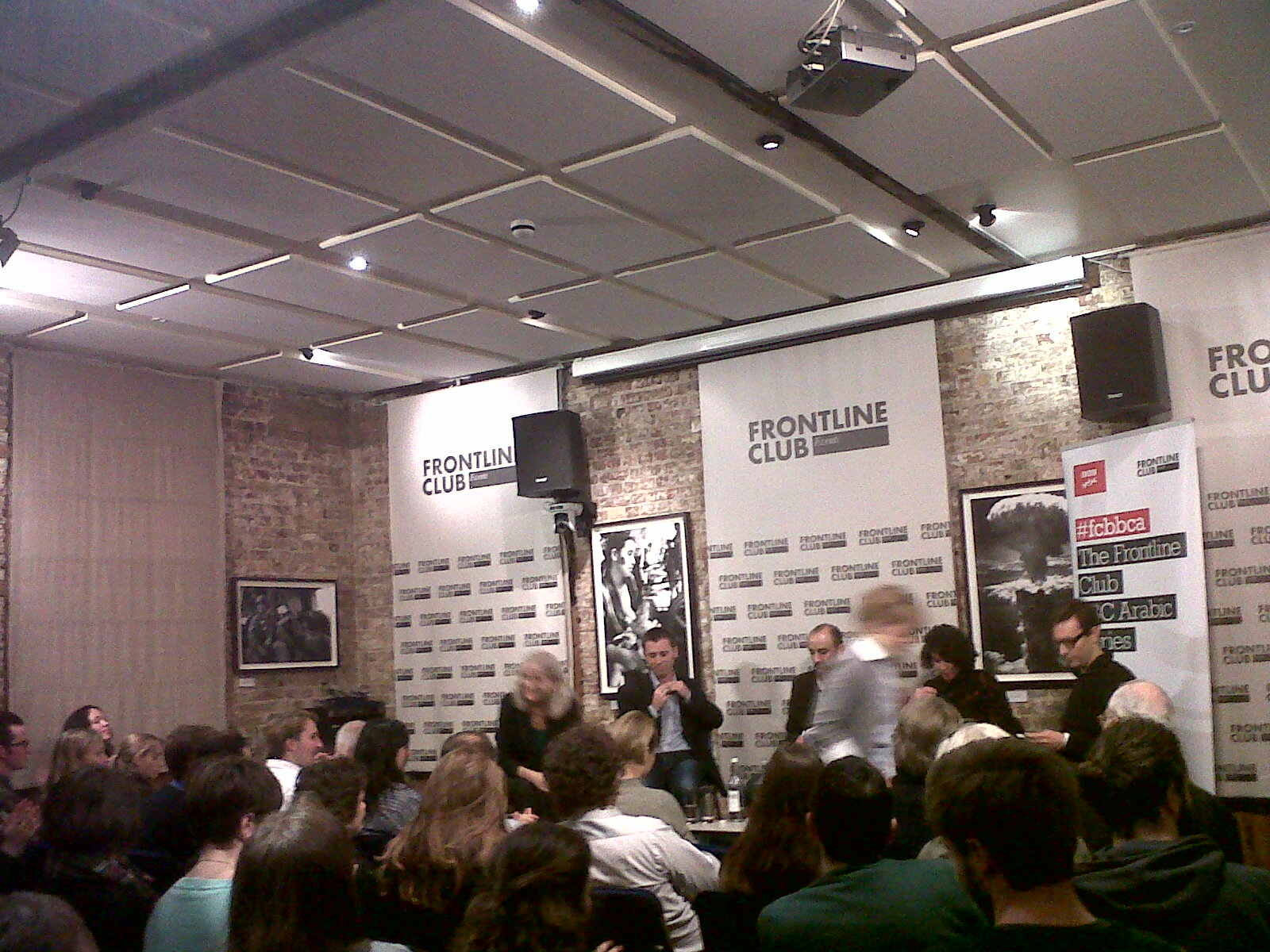
Dr Ian Brown kicked off proceedings by describing the distribution of power over cyberspace. Referring particularly to ICANN (Internet Corporation for Assigned Names and Numbers) which runs the international domain name system and although it is a “international facing” it is governed by US laws.
“Is it fair that this one powerful country the US should have such say over something that is a global resource?… Since so many large internet companies; the Googles, the Facebooks, the Twitters and so on, that are becoming increasingly important in internet governance debates, are headquartered in the US or at the very least have significant exposure to the US, and US law and case law has very firmly said that the behaviour of companies… with any assets exposed to the US had better watch out when it comes to their behaviour elsewhere in the world because there have been a number of US laws applied to the behaviour of these companies elsewhere in the world”
Karl Kathuria then moved on to discuss the censorship of information by governments from a more optimistic viewpoint, describing his time at the BBC on access to users in Iran and China:
“People were still able to get access to that content anyway, people are always looking for the content… its average everyday people who are reaching out.”
Birgitta Jónsdóttir has misgivings on calls for further global internet governance:
“Shouldn’t we have a global freedom of information act?… it is impossible… it would destroy the internet as it is today… maybe we need to start to look at this differently.”
Jacob Appelbaum, a core member of the anti snooping software Tor described the rise of cyber snooping and the oppression it can bring:
“Surveillance is a support system for violence.”
“What we see is a massive expansion of authoritarianism across the globe, even in so called free countries… the mere fact that it has gone so far and the American government has become so brazen.. is an incredibly bad sign, because in a lot of ways the US has led the world in these matters.”
“Freedom from suspicion is part of the necessity for feeling free… we should look at Facebook as stasi-book, and we should look at human data as human data-traffic. It is not a problem of over there-istan, it is a problem over here.”
Birgitta Jónsdóttir discussed the Iceland Modern Media Initiative as a solution to internet governance and excessive cyber snooping, and its uptake by the Icelandic Government to turn Iceland into a “safe haven” for freedom of information.
“Take the same concept as if you were to create a tax haven, so why not create the same for a freedom of expression and speech haven… if you have one country that sets the standard [other countries will rise to it]. I have a dream for a ‘Scandinavian Shield’… as the Scandinavian countries now have a good idea of the importance of these rights to bring the laws into the 21st century.”
Dr Ian Brown finished on a note about public uptake of new technology that can divert around any governmental snooping, “encouraging people to use the tools that already exist is the first step”.
View reaction to the debate on Twitter: #fcbbca, or watch the debate as it happened below.
]]>
In Iran it is reported that the government are building a national intranet that adheres to Islamic values and is isolated from the World Wide Web, in the UK the government is proposing a communications bill that will see an increase in monitoring of emails and social media by the police and intelligence agencies'.
With companies' interests lying in the commercial gains of data and governments' in the ability to monitor populations, join us as we ask to whose hands internet governance should be entrusted.
]]>
In Iran it is reported that the government are building a national intranet that adheres to Islamic values and is isolated from the World Wide Web, in the UK the government is proposing a communications bill that will see an increase in monitoring of emails and social media by the police and intelligence agencies’.
Authoritarian states have long seen the freedom of the internet as a threat and have tried to restrict it, but recent develops suggest a move towards increased tracking and control of what the public do and see online across the world.
With companies’ interests lying in the commercial gains of data and governments’ in the ability to monitor populations, join us as we ask to whose hands internet governance should be entrusted.
Chaired by Kirsty Hughes, the Chief Executive of Index on Censorship – an international freedom of expression non-governmental organisation. Previously she has worked at Chatham House, IPPR, the European Commission and most recently she was head of Global Public Policy and Advocacy at Oxfam and Senior Associate Fellow at the Centre for International Studies, University of Oxford. Twitter: @IndexCensorship
With:
Birgitta Jónsdóttir MP, a member of the Icelandic Parliament for The Movement and chairperson of the International Modern Media Institution. She has worked as a volunteer for various organisations including WikiLeaks, Saving Iceland and Friends of Tibet in Iceland. Prior to becoming an MP she has been an activist, writer, first icelandic woman to work as web developer and publisher. Twitter: @birgittaj
Jacob Appelbaum, an accomplished photographer, software hacker and world traveler. He works as a developer for The Tor Project and trains interested parties globally on how to effectively use and contribute to the Tor network. He is a founding member of the hacklab Noisebridge in San Francisco where he indulges his interests in magnetics, cryptography and consensus based governance. He was a driving force in the team behind the creation of the Cold Boot Attacks; winning both the Pwnie for Most Innovative Research award and the Usenix Security best student paper award in 2008. Additionally, he was part of the MD5 Collisions Inc. team that created a rogue CA certificate by using a cluster of 200 PlayStations funded by the Swiss taxpayers. The “MD5 considered harmful today” research was awarded the best paper award at CRYPTO 2009. Twitter: @ioerror
Karl Kathuria, an independent media technology consultant, specialising in Internet distribution and streaming media. Prior to this, he spent over 10 years at the BBC, managing the distribution of World Service Internet content to a global audience. In this role, he faced the challenge of delivering news content into countries where censorship is prevalent. As a result of these efforts, he was invited to the Munk School of Global Affairs in Toronto to work with the Citizen Lab team in 2011 on an independent research project. During this period, he studied the effects of the BBC’s content distribution strategies in China and Iran, and made recommendations for the propagation of circumvention software into these markets. His current projects include working with Psiphon Inc., the Canadian provider of network software aimed at preserving security, privacy, and access to content that may otherwise be blocked.
Dr Ian Brown, associate Director at the Cyber Security Centre and Senior Research Fellow at Oxford Internet Institute (OII). His work focuses on public policy issues around information and the Internet, particularly privacy, copyright and e-democracy. He also works in the more technical fields of information security, networking and healthcare informatics. He has consulted for the US Department of Homeland Security, JP Morgan, Credit Suisse, Allianz, McAfee, BT, the BBC, the European Commission, the Cabinet Office, Ofcom, the National Audit Office and the Information Commissioner’s Office.
]]> Renowned Arab journalist Yosri Fouda will be discussing the events that led him to this conclusion in the wake of President Hosni Mubarak's downfall and discussing how the Egyptian people have responded to the life sentence handed down to Mubarak for complicity in the deaths of protesters and their expectations following the presidential elections.
]]>
Renowned Arab journalist Yosri Fouda will be discussing the events that led him to this conclusion in the wake of President Hosni Mubarak's downfall and discussing how the Egyptian people have responded to the life sentence handed down to Mubarak for complicity in the deaths of protesters and their expectations following the presidential elections.
]]>
Renowned Arab journalist Yosri Fouda will be joining us for this special event to discuss events in Egypt in the 17 months since the toppling of president Hosni Mubarak and why he decided to suspend his talk show in protest against the efforts by military rulers to stifle free expression.
Fouda, who was editor and presenter of Last Word on Cairo-based ONTV, said there had been “a noticeable deterioration in media freedoms when he announced he would be “indefinitely suspending” his show in October last year.
The influential journalist will be discussing the events that led him to this conclusion in the wake of President Hosni Mubarak’s downfall and discussing how the Egyptian people have responded to the life sentence handed down to Mubarak for complicity in the deaths of protesters and their expectations following the presidential elections.
Yosri Fouda began his career at the BBC’s Arabic-subsidiary and was chief investigative reporter and executive producer for Al Jazeera. He is the co-author of Masterminds of Terror: The Truth Behind the Most Devastating Attack The World Has Ever Seen.
Picture credit: Gigi Ibrahim
]]>
Renowned Arab journalist Yosri Fouda will be joining us in conversation with senior BBC presenter and special correspondent Lyse Doucet for this special event, post elections we will be asking what lies ahead for the people of Egypt and its new leader.
]]>
Renowned Arab journalist Yosri Fouda will be joining us in conversation with senior BBC presenter and special correspondent Lyse Doucet for this special event, post elections we will be asking what lies ahead for the people of Egypt and its new leader.
Fouda, who was editor and presenter of Last Word on Cairo-based ONTV, said there had been “a noticeable deterioration in media freedoms when he announced he would be “indefinitely suspending” his show in October last year.
Following the presidential elections Fouda who chaired Egypt’s first presidential debate will be discussing events in Egypt in the 17 months since the toppling of president Hosni Mubarak and his hopes for the country post elections.
Yosri Fouda began his career at the BBC’s Arabic-subsidiary and was chief investigative reporter and executive producer for Al Jazeera. He is the co-author of Masterminds of Terror: The Truth Behind the Most Devastating Attack The World Has Ever Seen.
Picture credit: Gigi Ibrahim
]]>
Social media. Free speech. Democracy. These were the buzzwords of 2011, where international movements like the Arab Spring were said to have been fuelled by the power to communicate with one another without hindrance.
The year of unrest has put the spotlight on the role of the internet and social media in challenging power elites and their capacity to control what the outside world sees. But while the West praises ‘pro-democracy’ movements in Arab countries and their use of social media, Westerners face greater surveillance in the name of security, including threats of increased controls in the wake of the London riots.
“We’re becoming neighbours with each other,” said Timothy Garton Ash, director of the Free Speech Debate, a multi-lingual online platform for discussing freedom of expression which was launched in January 2012:
“The old ways of thinking about free speech – when in Rome, do as the Romans do – breaks down. But China and Iran do try to reassert their control over the internet, over the control of ideas."
“We have to have a global conversation about what should be the norms for freedom of expression.”
He was joined by Marie Gillespie, Professor of Sociology at The Open University and Co-Director of the Centre for Research on Socio-Cultural Change; Khaled Fahmy, professor and chair of the American University in Cairo’s Department of History; Kirsty Hughes, the Chief Executive of freedom of expression NGO Index on Censorship; to discuss what the historian and commentator has set out as the first principle of free speech: That all human beings must be free and able to express themselves, and to receive and impart information and ideas, regardless of frontiers:
“In this brave new world, private powers are at least as important as public powers. Facebook as a country would be the third largest country in the world. What Google does is more important than what Germany does.
“But they set rules without any democratic process. The internet also allows for new self-governing communities” said Garton Ash.
The highly academic debate – which some members of the audience dubbed “far too academic” and “Western” to be applied in actuality across the world – explored the pros and cons of Garton Ash’s ideal, outlined in ten draft principles supposed to be the ‘rules of thumb’ of free speech.
But Fahmy emphasised that the Egyptian revolution had “open access to information” at its core:
“It definitely isn’t a revolution of the poor and hungry – that might be just one dimension,” he said. “The need to inform was central in the revolution. We are in the middle of it.”
“It is not Islamists that pose the most serious threats to freedom of information. It is the military and all that is attached to it. It is the military we are fighting and the national security we are trying to challenge.”
But the ideals of equality and freedom of expression were brought into question by Gillespie, whose research suggested that structures of inequality found in reality are replicated in the media:
“Are we really all neighbours? The structure of inequalities that exist in the world are replicated and intensified online. It is important to think about who is talking and who, most importantly, is listening.”
Another blow to Garton Ash’s project was dealt by Hughes, who said that a global code as is outlined in the Free Speech Debate project could open up freedom of expression to government interference and top down control – which would undermine the idea completely:
“Do we need a global code? No, we have the Universal Declaration of Human Rights. Codes open up government interference and topdown control. It can lead to self-censorship.”
“But we still need to fight for freedom of expression,” she added. “Let’s have a conversation but not a code.”
Diverse voices explored and expressed the pros and cons of working towards such an ideal – and so in a sense, demonstrated Garton Ash’s project in action.
“We have to move from purely western universalism to a more universal universalism,” said Garton Ash:
]]>“The only way to do that is to put your own propositions on the table and be genuinely open to what someone in China, or Egypt, would say in response.”
In a year of unrest that began with the Arab spring and spread to Russia and the Ukraine, the spotlight has been on the role of the internet and social media in challenging power elites and their capacity to control what the outside world sees.
But as with China, the use of social media also raised questions about the relationship between the big global companies like Facebook, Twitter and Google with not only the activists who used them, but also with the regimes they were challenging.
We saw too that decisions made in the US and Europe about mobile phone security levels and government access to social media sites had consequences for those who were tracked down and imprisoned not only in Egypt but also in Iran.
As westerners face greater surveillance in the name of security, including threats of increased controls in the wake of the August 2011 riots, we will be joined by Timothy Garton Ash and a respected panel of experts to discuss what the historian and commentator has set out as the first principle of free speech: That all human beings must be free and able to express themselves, and to receive and impart information and ideas, regardless of frontiers.
Is it time to create a new global code that governs freedom of speech? We will be discussing this vital issue and examining what such a code would include.
Chaired by Sina Motalebi, editor of Persian Online and Interactive at the BBC World Service. He has worked for BBC since 2004 in various capacities including an online editor and director of Iran projects for World Service Trust (now known as Global Media Action), editor of interactivity and Head of Output on BBC Persian TV.
With:
Timothy Garton Ash, the director of Free Speech Debate, a multi-lingual online platform for discussing freedom of expression. He is Professor of European Studies in the University of Oxford, Isaiah Berlin Professorial Fellow at St Antony’s College, Oxford, and a Senior Fellow at the Hoover Institution, Stanford University. His essays appear regularly in the New York Review of Books and he writes a weekly column in the Guardian.
Marie Gillespie, Professor of Sociology at The Open University and Co-Director of the Centre for Research on Socio-Cultural Change. She researches transnationalism and diaspora cultures comparatively and historically. Recent projects include an exploration of the new politics of security via a collaborative ethnography of transnational news cultures in eight UK cities, a national survey with the BBC on the changing face of British humour and a large-scale study of the BBC World Service as a multi-diasporic institution. She was recently awarded an AHRC Public Policy Fellowship to assess the potential of social media for opening up transnational political debate, specifically in relation to the BBC Arabic Services.
Khaled Fahmy, professor and chair of American University in Cairo’s Department of History. He is author of several publications including Mehmed Ali: From Ottoman Governor to Ruler of Egypt, All the Pasha’s Men: Mehmed Ali Pasha, His Army and the Founding of Modern Egypt and The Body and Modernity: Essays in the History of Medicine and Law in Modern Egypt.
Kirsty Hughes, the Chief Executive of Index on Censorship – an international freedom of expression non-governmental organisation. She is a commentator on European and international affairs and has worked at Chatham House and written for Friends of Europe and the Centre for European Policy Studies in Brussels. She contributes to international and European media including the BBC, CNN, Al Jazeera, The Huffington Post and others.

]]>
Join us as we bring together a prominent panel to discuss the growing tensions between Iran, its neighbours and the West, the impact of the power struggles at the heart of government and looking at the future of the pro-democracy movement.
]]>
Recent months have seen increased tension between Iran, its neighbours and the West.
Israel’s concerns over Iran’s nuclear programme, the storming of the UK embassy in Tehran and the closure of the Tehran embassy have all played a part in ratcheting up tensions across the region.
Sanctions on the trade of its oil provoked warnings from Iran that they will close vital access to the strait of Hormuz.
As President Barack Obama warned against the “loose talk of war” Iran’s political elite is also focused on internal power struggles between the spiritual leader Ayatollah Ali Khamenei and president Mahmoud Ahmadinejad.
Join us as we bring together a prominent panel to discuss the growing tensions between Iran, its neighbours and the West, the impact of the power struggles at the heart of government and what role the pro-democracy movement still might play in the country’s future.
Chaired by Martin Fletcher, associate editor and former foreign editor of The Times.
With:
Ran Gidor, the Minister-Counsellor for Political Affairs at the Embassy of Israel in London. Prior to this he worked as the Head of the UK & Ireland Desk at the Israeli Foreign Ministry in Jerusalem. From 2000 to 2003 he served as the Cultural & Academic Attaché at the Embassy of Israel in Beijing, China. From 1997 to 2000, he served as the deputy Ambassador at the Embassy of Israel in Tbilisi, Georgia.
Azadeh Moaveni, Iranian-American writer, journalist and former Middle East correspondent for Time magazine. She is author of Lipstick Jihad and co-author, with Nobel Peace Prize winner Shirin Ebadi, of Iran Awakening.
Roberto Toscano, Italian Ambassador to Iran for five years (2003-2008). As a career diplomat, he has served in a number of other posts (India, Chile, USSR, Spain, United States, as well as at Italy’s Permanent Mission to the United Nations at Geneva). He is the author of books and articles on human rights, peacekeeping, conflict prevention, ethics and international relations.
Christopher de Bellaigue, a leading expert on modern Iran. Between 1996 and 2007, he lived and worked as a journalist in south Asia and the Middle East, writing for The Economist, the Financial Times, the Independent and the New York Review of Books. He is author of many books including most recently Patriot of Persia: Muhammad Mossadegh and a Very British Coup.
Picture credit: Daniella Zalcman
]]>By Emily Wight
Almost a year since the uprising began inSyria, 7000 people are estimated to have died at the hands of President Bashar al-Assad’s regime. The death this week of the revered journalist Marie Colvin – a founding member of the Frontline Club – has intensified the media spotlight on what has become a humanitarian crisis.
A panel of experts on the situation came to the Frontline Club on Friday for a #FCBBCA event exploring possible solutions to the situation.
Chaired by BBC Arabic presenter Rasha Qandeel, Crisis in Syria – what can be done? began with a tribute to Marie Colvin before Qandeel began the discussion.
The panel was nothing if not balanced. British-Iranian journalist Ramita Navai, a reporter for Channel 4’s documentary series Unreported World, focussed on the plight of Syrians; meanwhile Ammar Waqqaf, a member of the Syrian Social Club – which strives for regime reform rather than regime change – claimed that the killing of army members by rebels is commonplace.
Waqqaf also referred to a poll – the source of which he couldn’t say – showing that the majority of Syrians supported Assad. Navai found this hard to believe, recalling her time undercover with members of the opposition movement in October, when they found themselves under siege (“You couldn’t walk down the road to get bread”, she said).
Navai dismissed any speculation that the rebels weren’t simply ordinary people whose human rights had been trampled on by an oppressive regime:
“Who are the rebels? Who is the Free Syrian Army? They’ve taken to arming themselves to protect themselves and their families – it’s a natural progression. The activists are not terrorists.”
Navai also insisted that Assad has a stronger military than Gadaffi ever had inLibya.
Debate moved on to what can be done to stop further bloodshed. Scores of refugees have fled across the border toTurkey, but Qandeel spoke of latest BBC reports that the Syrian government has now lined their borders with landmines to kill anyone attempting to leave the country.
Should, then, the international community intervene? If so, how?
Dr Mouna Ghanem is a gender expert and vice-president of the political movement Building theSyrianState, which aims to unite Syrians with a variety of ideologies in forming a democratic and egalitarian state. She still has faith in diplomacy, saying:
“Only through international consensus among other countries – this is the only way for a safe exit strategy. We can stop the killing by creating an international consensus amongRussiaandChina.”
Others on the panel as well as audience members agreed that this is looking less and less likely.
The biggest controversy of the evening, however, came after Malik Al-Abdeh, Chief Editor of the Syrian opposition Barada TV, pointed towards the sectarian issue as the “elephant in the room”. The Syrian regime is dominated by Alawite Shiites; Al-bdeh claimed that “Sunni Arabs feel that the state doesn’t represent them.”
But Dr Ghanem insisted the situation was simply a question of pro- versus anti-Assad. Audience members spoke up; many had personal ties to theMiddle Eastand could shed light on their experiences. All were passionate about the humanitarian crisis unravelling in the country and hopeful that, somehow, it must come to an end.
]]>
The response of President Bashar Assad to the protests in Syria has been to launch a brutal crack down on his opponents that has reportedly led to the deaths of an estimated 6,000 people.
As the violence intensifies in the wake of the veto by Russia and China of the U.N. Security Council’s resolution condemning the violence, we will be discussing what options are now available to the people of Syria, the Free Syrian Army and President Bashar al-Assad and his regime.
What role should the international community play in the face this deepening crisis? Should the Arab League put more pressure on President Assad to cease the bombardment of rebel-held areas? What of the rest of the people of Syria, where does their support lie?
Chaired by BBC Arabic presenter Rasha Qandeel.
With:
Dr Mouna Ghanem, a Syrian politician and vice president of the Syrian political movement “building the Syrian state”. She is also a senior gender advisor with an extensive experience in the Arab region, mainly on women issues and reproductive health.
Ammar Waqqaf, member of the Syrian Social Club (a group of British Syrians and Syrians living in the UK, who prefer regime reform, rather than regime change.)
Ramita Navai, British-Iranian journalist and reporter for Channel 4’s foreign affairs series, Unreported World. Late last year she spent two weeks living undercover in Syria with members of the opposition movement.
Malik Al-Abdeh, chief editor of Barada TV a London-based Syrian opposition satellite channel and former BBC journalist.
]]>